
Padel Star Point rule: how it works
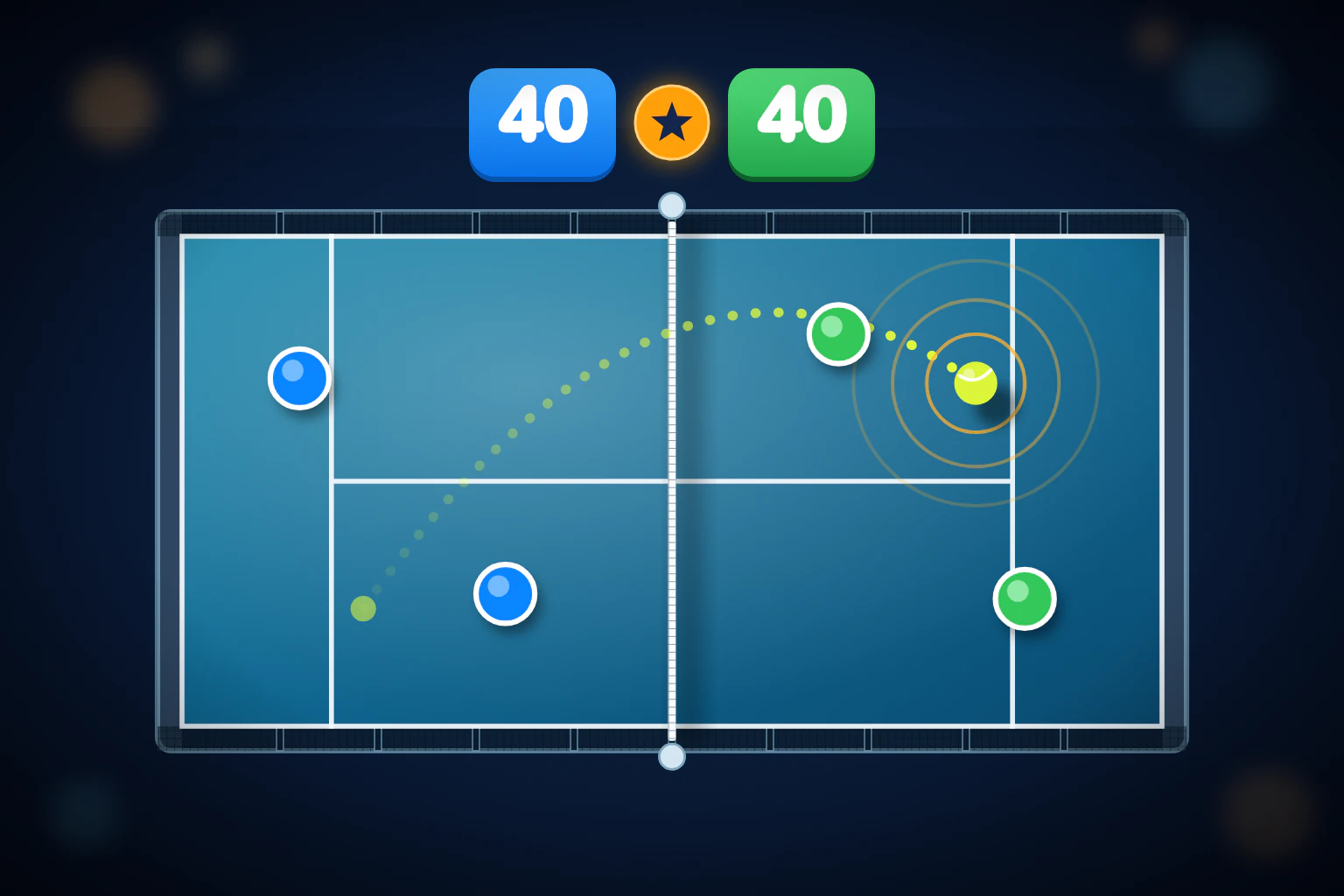
The Star Point is the FIP scoring method that ends a padel game after two advantages. At 40-40 you play up to two ordinary advantage cycles. If neither ends the game, the third deuce is settled by one deciding point, the Star Point, and whoever wins it wins the game. The FIP General Assembly approved it on 28 November 2025, and it applies from 1 January 2026 on Premier Padel, the CUPRA FIP Tour, FIP Promises and FIP Beyond.
How does the Star Point work?
The Star Point only matters when a game reaches deuce. Until then scoring is normal: 15, 30, 40, game. When both pairs have three points, the rulebook calls the score “deuce 1”. The next point gives “advantage 1”. If the pair with the advantage wins the following point, it wins the game. If it loses it, the score returns to “deuce 2” and the same thing happens once more with “advantage 2”. If the second advantage is lost too, the score is “deuce 3” and one deciding point, the Star Point, is played.
| Score called | What happens next |
|---|---|
| Deuce 1 | The next point gives advantage 1. |
| Advantage 1 | The pair with the advantage wins the game if it wins the next point. If it loses it, the score returns to deuce 2. |
| Deuce 2 | The next point gives advantage 2. |
| Advantage 2 | Win the next point and the game is won. Lose it and the score returns to deuce 3. |
| Deuce 3 | One deciding point, the Star Point. Its winner wins the game. |
Because two advantages are the most that can be played, a Star Point game lasts eleven points at most: six to reach the first deuce, then advantage 1, deuce 2, advantage 2, deuce 3 and the Star Point. An advantage game has no limit, and a golden point game lasts seven points at most.
Who chooses the side on the Star Point?
The receiving pair chooses whether to receive the serve on the right or the left side of the court, and the two receivers cannot change positions to do it. The rule is about the side, not about who serves. Because the receivers cannot swap, choosing the side decides which of them returns the point.
In mixed matches the receiving player is the one of the same sex as the server, and again the receivers cannot swap. The rulebook states no exception for the deciding point, so the usual padel serve rules apply.
How is the Star Point different from the golden point?
Both end a game with one deciding point, and the rule about choosing the side is the same. What differs is when the deciding point arrives. The golden point is played at the first deuce. The Star Point comes only after two advantage cycles have failed to finish the game. Advantage itself has no such limit.
| At 40-40 | Advantage | Golden point | Star Point |
|---|---|---|---|
| Advantage cycles before a decider | Unlimited | None | Up to two |
| Longest possible game | No limit | 7 points | 11 points |
| FIP Rules of Padel 2026 | Option 1 | Option 3 | Option 2 |
When was the Star Point introduced?
Several dates get quoted, and they belong to different events. The FIP General Assembly, which brings together 100 national federations, approved the Star Point unanimously on 28 November 2025 in Acapulco, Mexico. The FIP announced it publicly on 18 December 2025. The Rules of Padel that contain it carry the application date of 1 January 2026.
| Date | What happened |
|---|---|
| 28 November 2025 | The FIP General Assembly approves the Star Point unanimously, in Acapulco. |
| 18 December 2025 | FIP announces the Star Point and publishes the updated Rules of Padel. |
| 1 January 2026 | Rulebook application date: the Star Point applies. |
| 5 to 11 January 2026 | FIP Bronze Melbourne, first stage of the CUPRA FIP Tour, scheduled as the first event to use it. |
| 9 to 14 February 2026 | Riyadh P1, scheduled as the Premier Padel debut of the Star Point. |
FIP's schedule had it starting with the FIP Bronze Melbourne, the first stage of the CUPRA FIP Tour, and making its Premier Padel debut at the Riyadh P1. Those are the announced dates. Play by play, which match used it first, is not something the FIP documents record.
Which competitions use the Star Point?
FIP announced it for four circuits in 2026: Premier Padel, the CUPRA FIP Tour, FIP Promises and the amateur FIP Beyond. Their rulebooks confirm it, each with its own match format around it. Other competitions set their own scoring, and the Premier Padel, Promises and Beyond rulebooks say FIP may authorise other scoring systems in their tournaments.
| Circuit | Format around the Star Point |
|---|---|
| Premier Padel | The Star Point is used as described in the FIP Rules of Padel. Finals are best of three complete sets with a tiebreak and the Star Point. |
| CUPRA FIP Tour | All matches are best of three sets, every set is decided by a tiebreak, and the Star Point is used. |
| FIP Promises | Best of three: the first two sets use the Star Point and the final set is a match tie-break to 10. |
| FIP Beyond | The first two sets use the Star Point. What follows depends on the draw size: 16 players play best of three tie-break sets, 32 play two sets plus a super tie-break to 10, and 64 play best of three sets to four games with FIP approval. |
Does the Star Point replace the golden point?
On the FIP circuits it does, but the rulebook still lists all three methods. The Rules of Padel keep advantage (Option 1) and the golden point (Option 3) next to the Star Point (Option 2), and clubs, leagues and friendly matches can use whichever they agree on. The golden point has a history of its own, from World Padel Tour in 2020 to the FIP Tour rulebook, in the golden point guide.
Can you play the Star Point at your club?
Nothing stops you. It is Option 2 in the rulebook, and any club can use it for friendly matches and league games. What you need is a way to remember which deuce you are on, so call the score in FIP's words: “deuce 1”, “advantage 1”, “deuce 2” and so on. Everybody then knows whether the next deuce ends the game.
The Star Point only changes what happens at 40-40 inside a game. A set that reaches 6-6 still goes to a tiebreak, and the padel scoring rules cover the rest of the scoring. The free web scoreboard scores advantage and golden point, not the Star Point.
Questions people also ask
What is the Star Point in padel?
A FIP scoring method for games that reach deuce: up to two advantage cycles, then one deciding point at the third deuce. It applies from 1 January 2026 on Premier Padel, the CUPRA FIP Tour, FIP Promises and FIP Beyond.
Is the Star Point the same as the golden point?
No. Both end with one deciding point, but the golden point is played at the first deuce and the Star Point only at the third, after two advantage cycles. The side rule for the receivers is the same.
Learn more: Is the Star Point the same as the golden point?Who chooses the side on the Star Point?
The receiving pair chooses whether to receive on the right or the left side. The receivers cannot change positions, and in mixed matches the receiver is the player of the same sex as the server.
When did the Star Point start?
FIP approved it on 28 November 2025, announced it on 18 December 2025, and the Rules of Padel apply it from 1 January 2026.
Is silver point a padel rule?
Not in the FIP Rules of Padel. The 2026 rulebook lists advantage, the Star Point and the golden point. If a club or competition uses a silver point, it is a local rule, so ask how it works before you play.
Does Padel Score Tracker support the Star Point?
No. The app and the web scoreboard score advantage and golden point. There is no Star Point mode, so a Star Point game has to be counted by hand.
Learn more: Does Padel Score Tracker support the Star Point?Sources
- International Padel Federation, Rules of Padel (review of application 1 January 2026, PDF)
- FIP, “Between innovation and tradition: introducing the Star Point” (18 December 2025)
- Premier Padel Official Rulebook, Men's, version 2026
- CUPRA FIP Tour Rulebook, version 2026
- FIP Promises Tour Rulebook (application date 1 January 2026)
- FIP Beyond Rulebook