
Padel serve rules (2026)
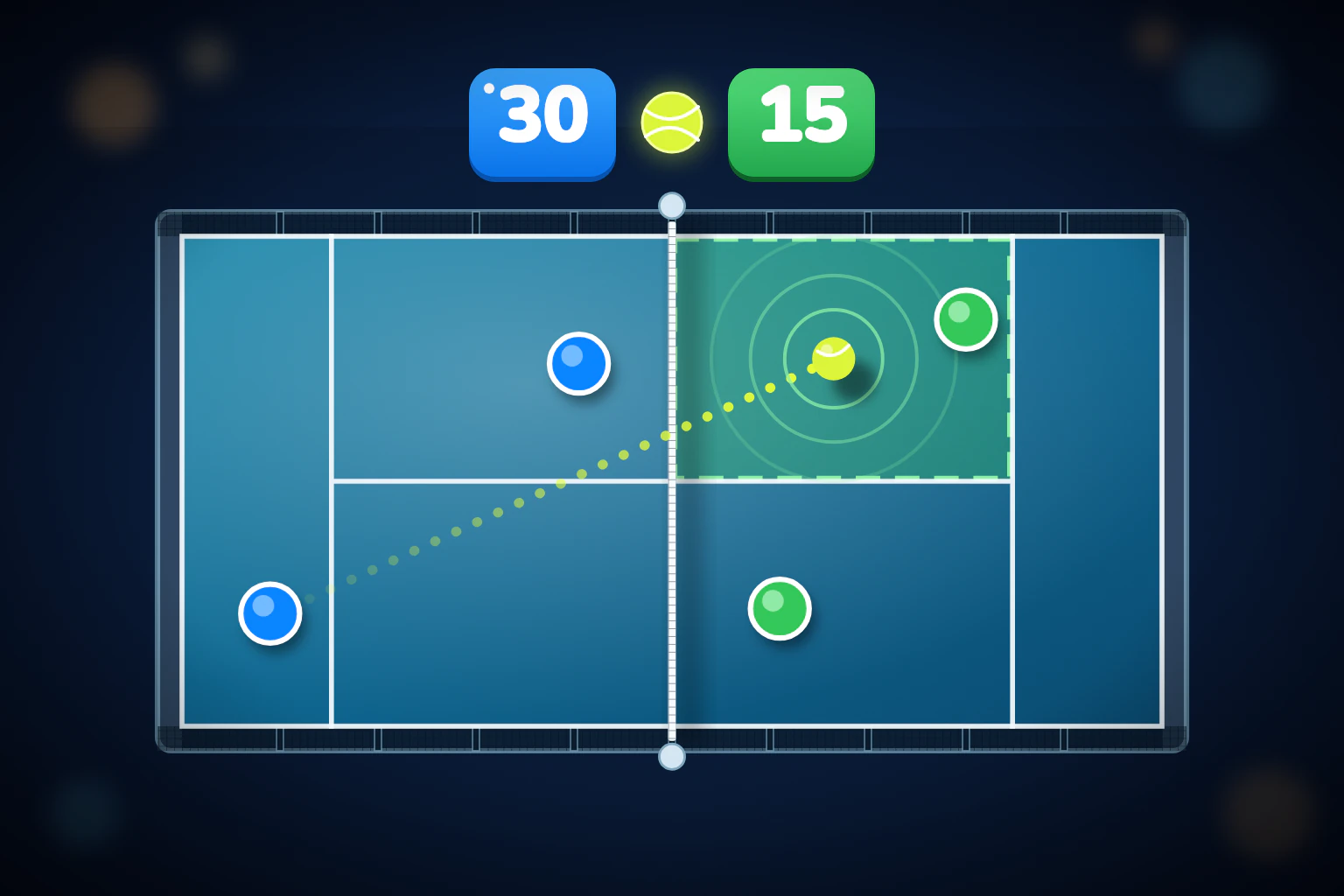
A padel serve is struck at or below waist height, which in practice means an underhand serve. The server bounces the ball inside their own service box, keeps at least one foot on the ground, and sends the ball diagonally over the net into the opposite service box. You get two serves. Under the FIP Rules of Padel that apply from 1 January 2026, the server needs one foot behind the service line, and the ball may not cross the service line before it is struck.
Serve in padel, step by step
- Take your position. Stand with at least one foot behind the service line, between the imaginary extension of the central line and the side wall, and stay there until the ball is served.
- Bounce the ball. Bounce the ball on the ground inside your own service box. It must not cross the service line, or its imaginary extension, before you hit it.
- Hit at or below waist height. Strike the ball at or below waist level with at least one foot in contact with the ground. Do not touch the service line or the central line with your feet before contact.
- Aim diagonally. Hit the ball over the net so it bounces inside the lines of the opposite service box. The lines count as good.
- Use the second serve if needed. If the first serve is a fault you get a second. Two consecutive faults lose the point.
What are the basic serve rules in padel?
Every point begins with a serve, and the server has two attempts. Rule 6 of the FIP Rules of Padel sets the conditions. The serve counts as made at the moment the racket touches the ball or intentionally tries to hit it.
Until the ball is hit, the server may not touch the service line, the imaginary extension of the central line, or the receiving box of their own side of the court with their feet.
What changed in the 2026 serve rules?
Some points about the serve read differently in the edition that applies from 1 January 2026 than in the 28 May 2021 edition. Only those two editions were compared, so the table says what is different, not the year each change was made.
| Point | 28 May 2021 edition | Edition applying from 1 January 2026 |
|---|---|---|
| Feet at the start of the serve | Both feet behind the service line. | One foot behind the service line. |
| The ball and the service line | No matching sentence. | The ball may not cross the service line, or its imaginary extension, until it is struck. |
| Walking, running or jumping | A player may not walk, run or jump while serving. Small foot movements that do not change the position are accepted. | That sentence is no longer in the text. At least one foot must still touch the ground when the ball is hit. |
The 2021 edition also printed case rulings, for example that a serve touching a wall, a light or the fence on the server's side before it lands in the box is a fault. Those rulings are not in the 2026 text, so check how your league reads that case.
What makes a serve a fault?
Rule 7 lists what makes a serve a fault, and the table below covers the common cases. Any breach of the position, bounce, height or line conditions in Rule 6 is a fault, and so is missing the ball. Two consecutive faults lose the point.
| What happens to the serve | Verdict |
|---|---|
| Lands in the box, then hits the glass or a solid wall | Good. The ball stays in play. |
| Lands in the box, then touches the metal mesh before the second bounce | Fault. |
| Lands on a line of the receiving box | Good. The lines count as part of the box. |
| Lands outside the receiving box | Fault. |
| Touches the net or a post, then lands in the box without touching the mesh first | Net. The serve is repeated. |
| Hits the server, the partner or anything they wear or carry | Fault. |
| The server swings and misses the ball | Fault. |
| Lands in the box, then leaves through the gate on a court with no safety zone | Fault. |
The padel specific part is what happens after the bounce. A ball that has bounced in the receiver's court and then hits any part of the court, including the glass and the solid walls, stays in play under Rule 12. The metal mesh is the exception for a serve: touch it before the second bounce and it is a fault.
What is a let or a net on the serve?
A serve that touches the net or a post and then lands in the receiver's box, without touching the mesh before its second bounce, is a net. A serve struck when the receiver is not ready is a let. Both are repeated. On a first serve the whole point is played again, with two serves. On a second serve only the second serve is repeated.
Lets during the rally are a separate rule: a split ball, an object on court or an outside interruption repeats the point, but the player has to call the let straight away.
What if the wrong player serves, or from the wrong side?
Serving from the wrong side is corrected as soon as it is noticed. All points won stand, and a fault on the first serve still counts. Serving out of turn works differently: the player who should have served takes over as soon as the mistake is found, the points stand, and a single earlier fault is not counted. If the game has finished before anyone notices, the serving order stays as it is until the end of the set.
A missed change of ends is handled the same way: correct it when noticed, and all points won stand. The full rotation is in the serve order guide.
Where does the serve go, and how is it returned?
The first serve of a game is hit from the right side, diagonally over the net into the opposite box (the one on the server's left), and the side alternates after every point. The receiver must let the ball bounce inside the receiving box and hit it before its second bounce. If the ball hits the receiving player or racket before it bounces, the point goes to the server.
On the deciding point of a golden point or Star Point game, the receiving pair chooses to receive on the right or the left, and the receivers cannot swap positions. The padel scoring rules put the serve in the context of a whole game, and the free web scoreboard tracks the serving pair through a game and a tiebreak.

Questions people also ask
Is the padel serve always underhand?
The FIP wording is that the ball must be struck at or below waist level with at least one foot on the ground. Underhand is the everyday description of a serve hit that low.
Can you jump when you serve in padel?
Not with both feet in the air. At least one foot has to touch the ground when you hit the ball, and you cannot touch the service line before the hit. The 2021 sentence banning walking, running or jumping while serving is not in the 2026 text.
Can a serve hit the glass in padel?
Yes, after it has bounced in the correct receiving box. A serve that bounces in the box and then touches the glass or a solid wall stays in play. If it touches the metal mesh before its second bounce, it is a fault.
How many serves do you get in padel?
Two. If the first serve is a fault the server takes a second, and two consecutive faults lose the point.
Learn more: How many serves do you get in padel?What happens if the serve hits the net?
If it touches the net or a post and then lands in the receiver's box without touching the mesh first, it is a net and the serve is repeated. On a first serve the whole point is replayed with two serves. On a second serve only the second serve is repeated.