
Padel Americano rules and format
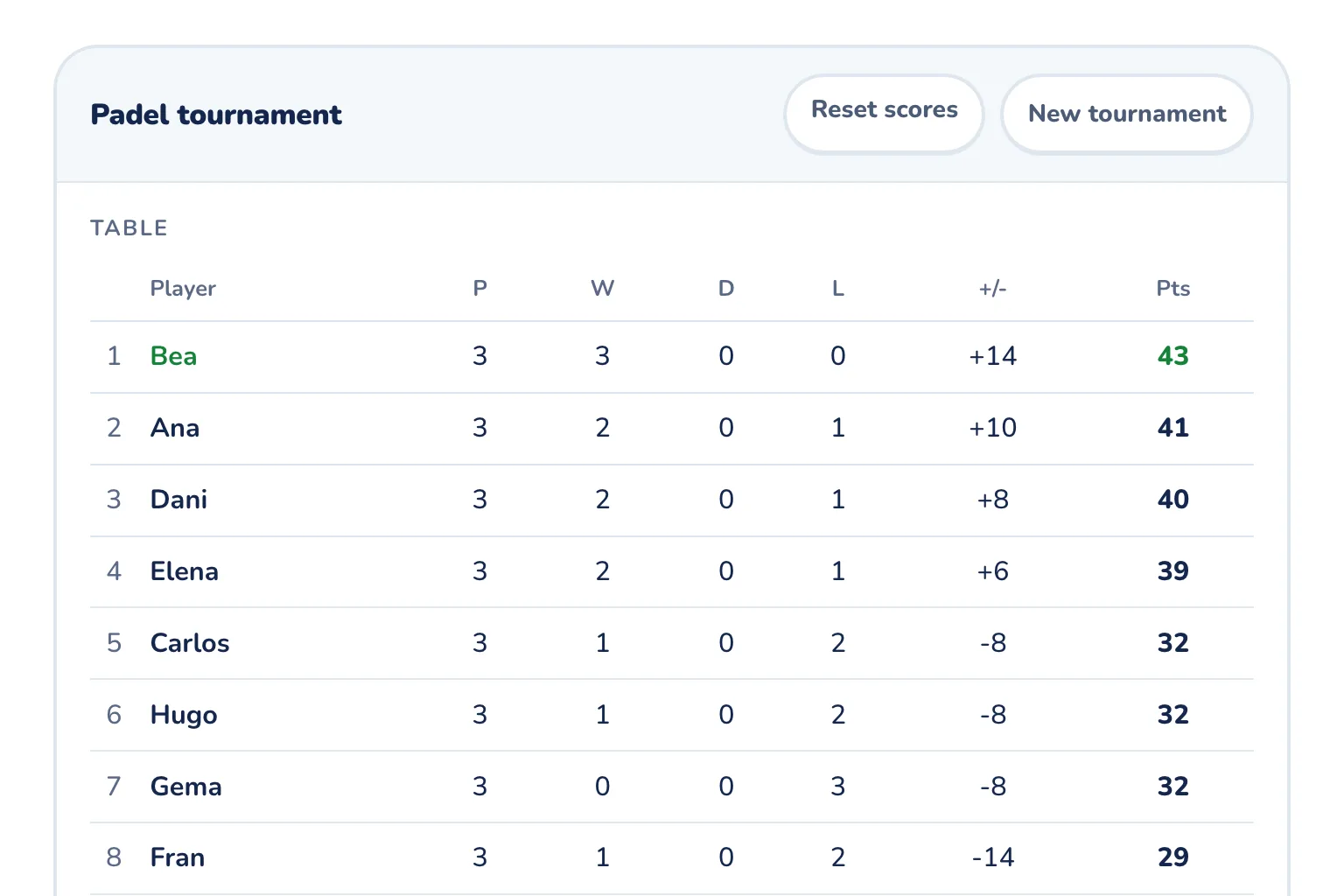
A padel Americano is a social tournament where partners change every round and every player keeps their own score. Each match is played to a fixed number of points, often 24, and each player banks the points their side won. After the last round, whoever has the most points wins. You need a multiple of four players for a clean draw, and one court for every four players. The free tournament generator draws the rounds and keeps the table.
How to run a padel Americano, step by step
- Count players and courts. Get a multiple of four players if you can, and one court for every four. With five, nine or thirteen players, one player sits out each round.
- Pick the points per match. Agree a fixed total such as 16, 24 or 32 points. A match ends when the two sides' points add up to it.
- Draw the rounds. Rotate partners so everyone plays with as many different people as possible. A generator does this for you and spreads the matches over your courts.
- Play and enter the score. Each player banks the points their side won in every match. With a fixed total, one side's score gives you the other.
- Rank by points won. After the last round, the player with the most points wins. Ties go to matches won, then point difference.
How does a padel Americano work?
Players sign up on their own, not as pairs. Each round, the draw puts them into new pairs and new matches, so over the evening you play with most or all of the group and against most of it too.
Nobody is knocked out. Everyone plays every round unless the numbers force someone to sit out, which is why Americano is the format clubs reach for on social nights and why it works for mixed levels: a strong player cannot win alone, because their partner changes every match.
Inside a match there are no games or sets. You play points and count them straight up, with no 15, 30, 40. That keeps every match the same length and makes the scoring something anyone can follow, unlike the standard padel scoring with its deuces and tiebreaks.
Americano scoring: points per match
The organiser sets a total, and a match ends when the two sides' points add up to it. With 24 points, a match can finish 15-9, 12-12 or 20-4. Each of the two players on a side banks that side's number, so a 15-9 win gives both winners 15 and both losers 9.
That is the clever part. Losing 11-13 still earns you 11, so close defeats count and blowouts hurt. A player who loses narrowly all night can beat one who wins a couple and gets crushed in the rest.
Pick the total by how much time you have. The minutes below are a rough guide for a social level, and they vary a lot with how long rallies last.
| Points per match | Rough match length | Good for |
|---|---|---|
| 16 | 8 to 10 minutes | Many rounds in a short slot |
| 21 | 10 to 12 minutes | A 90 minute session |
| 24 | 12 to 15 minutes | The usual default |
| 32 | 16 to 20 minutes | Fewer, longer matches |
Who serves in an Americano?
There is no single rulebook for Americano, so serving is a house rule. The usual one is to give each player a block of serves in a row, such as four, and rotate through all four players, so everyone serves the same amount whatever the total.
Agree it before the first ball. The rest of the serve, from where you stand to what counts as a fault, follows the normal padel serve rules.
How many players, rounds and courts?
Four players per court. Eight players need two courts, twelve need three, sixteen need four. With a number that does not divide by four, the extra players sit out a round in turn, and the draw should make sure nobody sits out twice before everyone has sat out once.
With eight players, seven rounds is the classic Americano: everyone partners every other player exactly once and faces each one twice. Bigger groups rarely have time for a full rotation, so they play as many rounds as the court booking allows.
Partner rotation is the fiddly part to do by hand. The tournament generator finds a schedule where nobody repeats a partner for 4, 5, 8, 12, 13, 16, 17 and 20 players, and the fewest repeats for other numbers.
| Players | Courts | Sitting out each round |
|---|---|---|
| 4 | 1 | None |
| 5 | 1 | One player |
| 8 | 2 | None |
| 12 | 3 | None |
| 16 | 4 | None |
Americano, Mexicano and Team Americano
Mexicano keeps the points per match but builds each round from the table instead of a fixed rotation. After the first round, players are grouped by their score, so the matches get more even as the evening goes on. It suits groups of different levels who want close games, at the cost of less mixing.
Team Americano, also called a round robin, keeps pairs fixed for the whole event. Every pair plays every other pair and a table ranks the pairs. It is the better choice when people arrive with a partner and want to play as a team.
The tournament generator runs all three, plus knockout. In Mexicano mode it draws each new round from the table as soon as the last score of the round is in: first and fourth against second and third on court one, and so on down the table.
Questions people also ask
How many points is an Americano match?
Whatever the organiser sets. 24 is the most common total, with 16 or 21 for short sessions and 32 for longer matches.
Can you play an Americano with 6 or 10 players?
Yes. With 6 players, one court is used and two players sit out each round; with 10, two courts and two sitting out. The draw rotates who sits out so it stays fair.
How do you break a tie in an Americano?
There is no official rule. A common order is points won, then matches won, then point difference, which is what the tournament generator uses.
Does a draw count in an Americano?
With an even total such as 24, a match can finish 12-12. Each player banks 12 and nobody gets a win. With an odd total such as 21, a draw cannot happen.
Can I keep Americano scores on Padel Score Tracker?
The app scores standard matches with games and sets. For an Americano, use the free web tournament generator, which handles points per match, partner rotation and the table.